
Leadership Solutions for Organizations
Operating Under Pressure
Build leadership capacity. Strengthen trust. Improve execution.
Soltys Leadership Group provides executive advisory, coaching, leadership development, team alignment, and construction-focused leadership solutions for organizations navigating growth, complexity, and increasing responsibility.
The work is built around a simple challenge: as organizations grow, leadership capacity must grow with them.
Through Identity-Driven Leadership™, leaders strengthen the identity, emotional intelligence, trust, accountability, and collective leadership behaviors required to perform consistently under pressure.
Leadership development should not stop at better individual leaders. It should build greater organizational capability.

Identity-Driven Leadership™
From who the leader is to what the organization becomes.
Leadership performance does not begin with technique. It begins with identity.
Identity-Driven Leadership™ develops leadership as an interconnected system—strengthening the individual leader, the quality of leader–team relationships, the culture those relationships create, and the organizational performance that follows.
The framework integrates doctoral research with decades of construction, operational, and leadership experience to connect human behavior with real organizational outcomes.
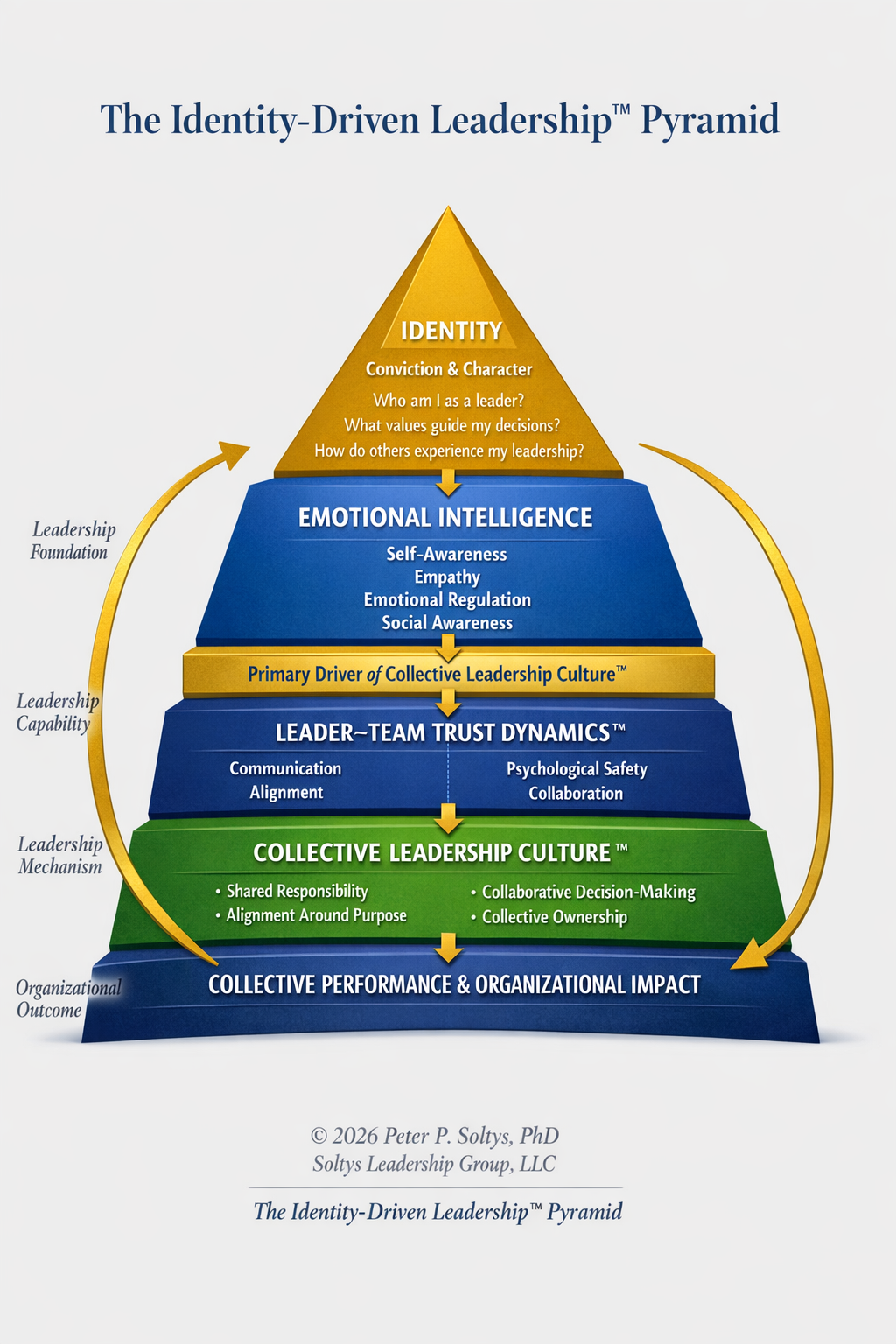
The framework progresses from individual identity through Emotional Intelligence and Leader–Team Trust Dynamics™ into Collective Leadership Culture™ and ultimately Collective Performance & Organizational Impact.
Leader–Team Trust Dynamics™
Trust is where leadership becomes relational.
High-performing teams are not built through structure alone. They are built through the quality and consistency of the relationship between leaders and their teams.
Leader–Team Trust Dynamics™ defines how leadership behavior strengthens—or weakens—trust, communication, accountability, psychological safety, and decision confidence over time.
When trust is weak, communication fragments and execution becomes reactive. When trust is strong, teams operate with greater clarity, speed, accountability, and shared ownership.
Communication Clarity
Expectations, decisions, and intent are understood across levels.
Relational Consistency
Words, actions, and decisions remain aligned—especially under pressure.
Accountability Alignment
Ownership is reinforced without creating fear-driven compliance.
Psychological Safety
Teams can surface risk, challenge assumptions, and speak without hesitation.
Decision Trust
Teams maintain confidence in leadership direction during uncertainty.
Leader–Team Trust Dynamics™ operates at the relational level. Collective Leadership Culture™ scales those trust patterns across the organization.
Stronger trust reduces friction, strengthens alignment, and improves execution.
Collective Leadership Culture™
Where trust becomes shared leadership behavior.
High-performing organizations are not sustained by individual leaders alone. They are strengthened when leadership expectations, behaviors, and accountability become consistent across teams.
Collective Leadership Culture™ represents the point where strong leader–team relationships begin to scale into shared organizational norms—how people communicate, make decisions, take ownership, and respond under pressure.
Culture is not declared. It is reinforced through repeated leadership behavior.
Shared Expectations
Leaders and teams operate from shared standards, priorities, and decision principles.
Behavioral Consistency
Leadership actions remain predictable, credible, and aligned across environments.
Collective Accountability
Ownership is distributed and reinforced without overreliance on positional authority.
Aligned Communication
Intent, expectations, and direction remain clear across teams and levels.
Cultural Cohesion
Teams share a common understanding of how leadership and work are expected to happen.
Leader–Team Trust Dynamics™ strengthens leadership at the relational level. Collective Leadership Culture™ extends those patterns across the organization.
When leadership behavior becomes consistent across teams, culture becomes an organizational capability—not simply the influence of individual leaders.

Designed for Leaders Operating in Complexity
Leadership gets tested when pressure exposes what ordinary conditions can hide.
Complex environments rarely struggle because leaders lack intelligence or technical expertise. They struggle when growth, pressure, competing priorities, and uncertainty expose weaknesses in alignment, trust, communication, and decision-making.
This work is designed for leaders and organizations that need leadership to remain clear, credible, and consistent when the environment becomes more demanding.
This work is especially relevant when:
Growth is outpacing leadership capacity
Strong performers are moving into broader roles faster than the organization can prepare them.
Executive alignment is weakening
Leaders are operating from different assumptions, priorities, or expectations.
Trust and communication are deteriorating
Friction begins slowing decisions, collaboration, and execution.
Culture is becoming inconsistent
Leadership expectations vary across teams, locations, or levels of the organization.
Designed for:
Executives & Senior Leaders
Operating in high-accountability, time-sensitive, and complex environments.
Leadership Teams
Working through misalignment, trust breakdown, or execution inconsistency.
Founder-Led & Privately Held Organizations
Building leadership depth beyond the founder or a small senior team.
Organizations Navigating Growth or Change
Strengthening leadership capacity while protecting culture, accountability, and performance.
Complexity does not create leadership weakness. It reveals it.
The objective is not simply to help leaders handle more pressure. It is to build leadership capacity that remains effective as the organization becomes more complex.

Strategic Engagement Process
Clarity is not accidental. It is developed, reinforced, and translated into leadership practice.
Every engagement is shaped around the organization’s needs, but the work typically moves through four connected areas—clarifying leadership, strengthening trust and alignment, building leadership capacity, and embedding those behaviors into the organization.
Identity-Driven Leadership™, Leader–Team Trust Dynamics™, and Collective Leadership Culture™ provide the framework. The engagement process translates that framework into practical leadership development and organizational action.
Phase 1 — Leadership Clarity
We begin by understanding the leadership environment and establishing clarity around identity, expectations, and decision-making.
Focus may include:
Leadership identity and decision principles
Emotional discipline under pressure
Values and behavioral expectations
Leadership consistency and role clarity
Outcome:
Greater clarity, consistency, and intentional leadership behavior.
Phase 2 — Trust & Alignment
Next, we examine how leadership behavior, communication, and relationships affect alignment across teams.
Focus may include:
Leader–Team Trust Dynamics™
Communication and decision friction
Psychological safety and accountability
Alignment across leaders, teams, and functions
Outcome:
Stronger trust, clearer communication, and greater alignment.
Phase 3 — Leadership Capacity Development
We strengthen leaders so they can carry greater responsibility without increasing dependence on senior leadership.
Focus may include:
Executive and emerging-leader development
Decision-making and leadership judgment
Relational effectiveness and influence
Leadership under pressure
Outcome:
Greater leadership depth, stronger judgment, and more capable leaders across the organization.
Phase 4 — Culture & Organizational Integration
Finally, strengthened leadership behaviors are reinforced across teams so they become part of how the organization operates.
Focus may include:
Collective Leadership Culture™
Shared leadership expectations
Accountability and behavioral consistency
Alignment between leadership intent and execution
Outcome:
Leadership becomes embedded across the organization rather than concentrated in a few individuals.
Ongoing Coaching & Reinforcement
Leadership change requires reinforcement. Executive coaching, team alignment, and periodic recalibration help sustain progress as responsibilities, teams, and organizational demands evolve.
The objective is not dependency on an advisor. It is greater leadership capability within the organization.
This is applied leadership development—not generic training.
Engagements operate at the leadership and organizational level, strengthening people, relationships, culture, and execution—not providing operational project management or construction delivery.

Outcomes You Can Expect
Engagements are designed to produce observable, leadership-driven outcomes across decision-making, trust, alignment, and execution.
Greater decision clarity under pressure
Stronger leadership presence and emotional discipline
Improved trust and alignment across teams and leadership levels
Reduced communication and execution friction
Greater consistency between strategic intent and day-to-day execution.
Stronger leadership capacity rooted in identity, credibility, and trust.
The Result:
Leadership becomes a driver of performance—not a source of variability.
Decisions become clearer.
Alignment becomes stronger.
Execution becomes more consistent.