
Identity-Driven Leadership™ Strategy for High-Stakes Construction
and Executive Teams
Executive coaching, leadership development, and advisory support for leaders operating in high-stakes, high-pressure environments.
Informed by experience across complex construction and organizational environments. Applied wherever leadership must perform under pressure.
High-stakes construction and executive environments demand more than technical expertise. They require emotional discipline, relational trust, cultural alignment, and sound decision-making under sustained pressure.
As a construction leadership strategist and executive advisor, I integrate lived field experience with doctoral research in Emotional Intelligence, Leader–Team Trust Dynamics™, and Collective Leadership Culture™—translating complex human dynamics into measurable alignment, culture strength, and performance through a structured leadership system.
Strategy begins with identity — aligns through trust — and scales through disciplined execution.

The Soltys Identity-Driven Leadership Framework™
Executive Leadership Architecture for High-Pressure Environments
Real executive authority begins with identity.
When leaders understand who they are—and lead from that foundation—clarity replaces reaction, alignment replaces friction, and culture reinforces strategy.
The Soltys Identity-Driven Leadership Framework™ integrates Identity, Emotional Intelligence (EI), Leader–Team Trust Dynamics™, and Collective Leadership Culture™ into a structured leadership system designed for high-pressure construction and complex organizational environments.
This framework is applied across organizations where leaders operate under pressure, growth, and accountability.
The framework represents an independently developed leadership system designed to translate real-world experience and research into practical execution.
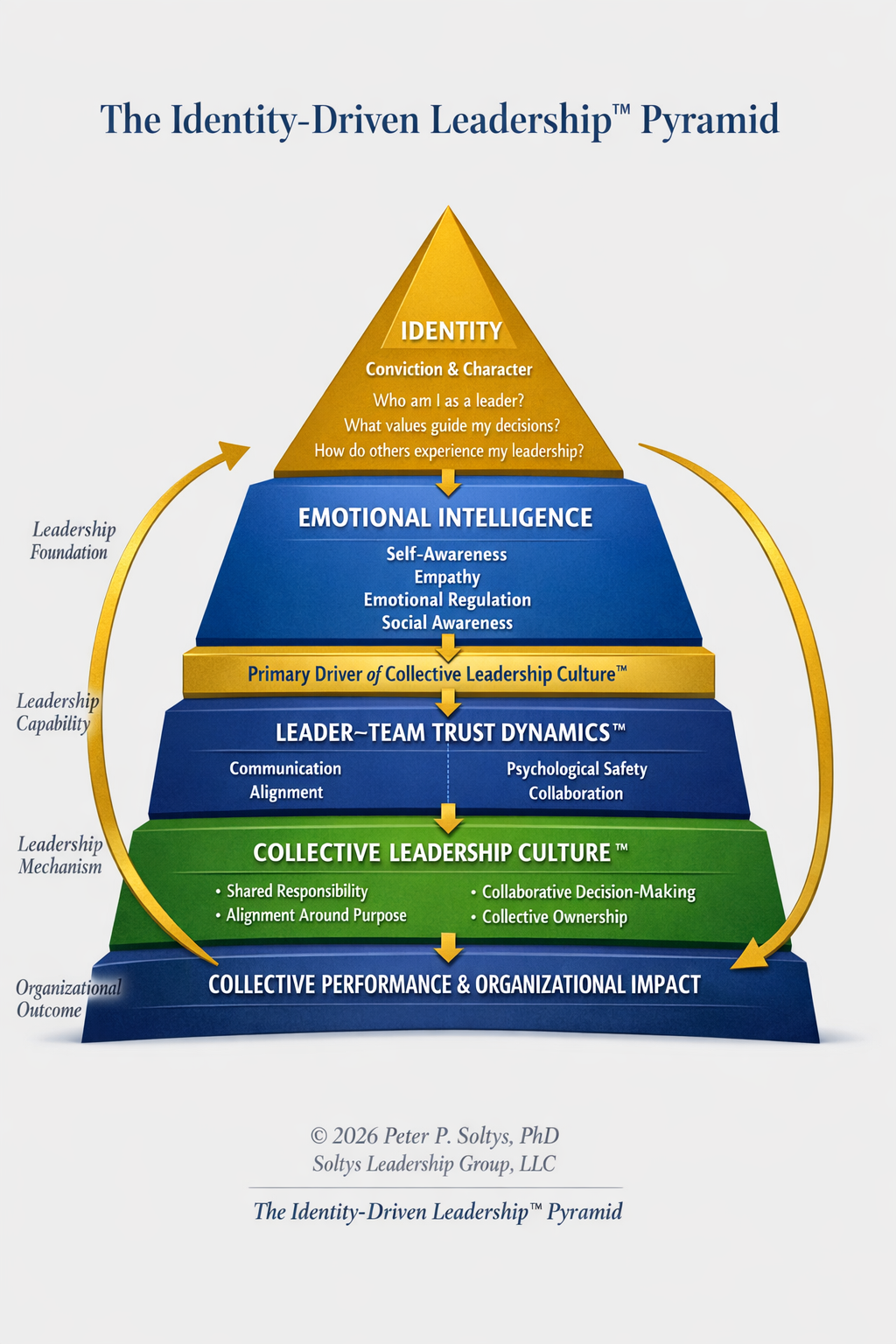
Identity shapes clarity → clarity shapes communication → communication shapes culture → culture shapes performance
How the System Works
Leadership performance is built in layers:
Identity establishes clarity, conviction, and decision discipline
Emotional Intelligence enables self-awareness, regulation, and relational effectiveness
Leader–Team Trust Dynamics™ strengthens communication, alignment, psychological safety, and collaboration
Collective Leadership Culture™ scales those dynamics across the organization—driving shared ownership, alignment, and sustained performance
Pillar 1
Identity & Clarity
Leadership effectiveness begins internally.
Before influencing others, executives define values, decision principles, and non-negotiables. Identity clarity creates emotional stability under pressure and eliminates reactive leadership.
When identity is clear, execution becomes consistent.
Pillar 2
Alignment & Cultural Cohesion
Strategy fails when culture pulls in competing directions.
This pillar strengthens organizational alignment, reinforces trust across leadership tiers, and integrates cultural cohesion into strategic execution.
Strong culture reinforces strategy. Weak culture fractures it.
Pillar 3
Authority Through Connection
Authority is earned through trust — not title.
Grounded in Leader–Team Trust Dynamics™ and Emotional Intelligence (EI), this pillar strengthens relational credibility, executive presence, and trust-based influence across teams and stakeholders.
Connection creates sustainable authority.
Pillar 4
Execution Under Pressure
In high-stakes environments, strategy must perform under complexity.
This pillar translates identity and alignment into disciplined execution—ensuring decisions, accountability structures, and leadership behavior reinforce measurable performance.
Execution is where identity proves itself.
From Trust to Culture at Scale
Leader–Team Trust Dynamics™ operates at the relational level—strengthening how leaders and teams communicate, align, and perform.
Collective Leadership Culture™ operates at the organizational level—scaling those dynamics into shared ownership, alignment, and consistent execution.
Originally shaped through experience in complex, high-pressure environments
Leader–Team Trust Dynamics™
It operationalizes how leadership behavior translates into measurable team performance outcomes.
The Mechanism That Drives Team Performance:
High-performing teams are not built through structure alone.
They are built through the quality of relationships between leaders and their teams.
Leader–Team Trust Dynamics™ defines how trust is established, reinforced, and sustained through consistent leadership behavior—especially under pressure.
When trust is weak, communication fragments, alignment deteriorates, and execution becomes reactive.
When trust is strong, teams operate with clarity, speed, accountability, and shared ownership.
How Leader–Team Trust Dynamics™ Works:
Trust is not a single action—it is a pattern of consistent leadership behaviors over time.
This system strengthens:
Communication clarity — ensuring expectations, decisions, and intent are understood across all levels
Relational consistency — aligning words, actions, and decision-making under pressure
Psychological safety — enabling teams to surface risk, challenge assumptions, and engage without hesitation
Accountability alignment — reinforcing ownership without creating fear-driven compliance
Decision trust — building confidence in leadership direction during uncertainty
Applied Through Leadership Development & Advisory:
Leader–Team Trust Dynamics™ is applied through executive coaching, leadership training, and organizational advisory engagements designed to strengthen trust at the leader–team level.
Applications include:
Executive coaching focused on trust-based leadership and relational effectiveness
Leadership workshops that strengthen alignment, communication, and accountability
Team diagnostics assessing trust, communication patterns, and execution friction
Advisory engagement to improve collaboration, decision-making, and operational performance
The Result:
As trust strengthens, teams shift from coordination to cohesion.
Leaders gain:
Greater influence without reliance on positional authority
More consistent execution across teams and projects
Reduced friction in communication and decision-making
Stronger alignment between strategy and day-to-day operations
Leader–Team Trust Dynamics™ is the engine that enables leadership performance under pressure.
“Over time, these trust patterns don’t stay contained within teams — they scale across the organization.”
Collective Leadership Culture™
It defines how leadership behavior scales into consistent, organization-wide performance.
Where Trust Becomes Organizational Performance:
High-performing organizations are not defined by individual leaders alone.
They are defined by how leadership behaviors scale across the organization.
Collective Leadership Culture™ represents the point where consistent leadership, strong trust dynamics, and aligned behaviors become embedded into how the organization operates.
It is not a program.
It is not an initiative.
It is how leadership shows up—everywhere, every day.
How Collective Leadership Culture™ Develops:
Culture is not declared—it is reinforced through consistent patterns of leadership behavior across teams.
As Leader–Team Trust Dynamics™ strengthens, it creates the conditions for culture to scale:
Shared expectations — leaders and teams operate from aligned standards and decision principles
Behavioral consistency — leadership actions are predictable, stable, and trusted across environments
Aligned communication — messaging, intent, and direction remain clear across all levels
Collective accountability — ownership is distributed and reinforced without breakdown under pressure
Cultural cohesion — teams operate with a shared understanding of how work gets done
Applied Through Organizational Leadership Strategy:
Collective Leadership Culture™ is developed through leadership strategy, team alignment, and organizational advisory engagements designed to scale leadership effectiveness across the enterprise.
Applications include:
Organizational alignment and culture assessment
Leadership strategy development aligned to execution demands
Cross-team trust and communication alignment initiatives
Executive advisory focused on scaling leadership consistency
Integration of leadership behaviors into operational systems and decision-making
The Result:
As culture strengthens, performance stabilizes and scales.
Organizations gain:
Greater consistency between strategy and execution across teams
Reduced fragmentation between departments, functions, and leadership levels
Stronger alignment during growth, change, or operational pressure
Increased accountability without reliance on control-driven leadership
A culture that sustains performance beyond individual leaders
Collective Leadership Culture™ is how leadership becomes an organizational capability—not an individual trait.

Designed for Leaders Operating in Complexity
High-stakes environments rarely fail due to lack of intelligence.
They break under misalignment, cultural drift, emotional reactivity, trust erosion, and execution breakdown under pressure.
This work is designed for leaders who understand:
Strategy without identity lacks stability
Alignment without cultural cohesion collapses under stress
Authority without trust is positional—not influential
Execution without discipline becomes reactive
Who This Work Serves:
This framework is designed for:
Executives and senior leaders operating in high-pressure, time-sensitive environments—including construction and capital-intensive industries
Executive teams experiencing misalignment, trust breakdown, or execution inconsistency
Founder-led or privately held organizations building scalable leadership architecture
Organizations navigating growth while protecting culture, accountability, and performance
High-performing leaders stepping into broader enterprise-level responsibility
Why This Matters:
Performance is not sustained by strategy alone.
It is sustained by alignment—across identity, trust, and culture.
When these elements are aligned:
Decisions accelerate
Communication becomes precise
Teams operate with clarity and ownership
Execution stabilizes under pressure
If performance matters, alignment must come first—and alignment begins with identity.

Strategic Engagement Process
Clarity is not accidental.
It is structured, developed, and reinforced through disciplined
leadership systems.
This engagement process translates Identity-Driven Leadership™, Leader–Team Trust Dynamics™, and Collective Leadership Culture™ into measurable leadership and organizational performance outcomes.
Phase 1 — Identity & Leadership Clarity
We begin by establishing clarity at the leadership level—where decision-making, behavior, and direction originate.
This phase focuses on:
Leadership identity, narrative, and decision principles
Emotional discipline and response patterns under pressure
Values alignment and leadership consistency
Clarity of expectations and behavioral standards
Objective:
Eliminate reactive leadership and establish stable, identity-driven authority.
Phase 2 — Alignment & Cultural Mapping
Next, we assess how leadership behavior, communication, and trust operate across the organization.
This phase examines:
Organizational alignment across strategy, culture, and execution
Communication clarity and breakdown points
Leader–Team Trust Dynamics™ and relationship quality
Cultural cohesion and collective accountability patterns
Execution friction across teams, departments, or projects
Objective:
Strengthen trust, alignment, and communication as the foundation for scalable performance.
Phase 3 — Authority Through Connection
Here we strengthen leadership influence through trust, consistency, and relational effectiveness.
Focus areas include:
Executive presence and emotional discipline
Trust-based leadership and relational consistency
Communication precision in high-stakes environments
Influence without reliance on positional authority
Objective:
Build sustainable leadership authority rooted in trust, credibility, and connection.
Phase 4 — Execution Architecture & Performance
Finally, we translate clarity, alignment, and trust into disciplined execution systems.
This phase supports:
Strategic implementation mapping
Accountability structure refinement
Leadership behavior calibration across teams
Alignment between strategic intent and operational execution
Objective:
Ensure leadership behavior consistently produces measurable operational results.
Ongoing Executive Coaching & Integration
Sustainable change requires reinforcement.
Ongoing support ensures leadership behaviors, trust dynamics, and cultural alignment are maintained and scaled over time.
This includes:
Executive coaching and leadership reinforcement
Team integration and alignment support
Continuous calibration of leadership behavior and performance expectations
Objective:
Sustain performance gains and embed leadership as an organizational capability.
This is applied leadership architecture—not theoretical consultation.
Engagements are designed at the leadership and organizational level, focusing on alignment, communication, and performance systems—not on operational project delivery.

Outcomes You Can Expect
Engagements are designed to produce measurable, leadership-driven performance outcomes:
Increased clarity in executive decision-making under pressure
Stronger leadership presence, emotional discipline, and communication precision
Improved trust across teams, functions, and executive levels—driving alignment and execution consistency
Reduced friction across departments, operations, and project environments
Greater consistency between strategic intent and day-to-day execution
Sustainable leadership authority rooted in identity, credibility, and trust—not title
Leadership influence becomes intentional, consistent, and scalable
The Result:
Leadership becomes a driver of performance—not a source of variability.
Execution stabilizes.
Alignment strengthens.
Performance scales.